Giselle is a ballet-play that shows two men’s love to a woman: first man is a stalker of Giselle, the woman, and the other man was a newcomer courting Giselle. Giselle splits in two acts, the first act involves the courting and fighting of the two men to be with Giselle. On a feminist’s point-of-view, the first act portrays the traditional feminine figure of women, which can be observed in the act wherein the mother of Giselle came out of their house while Giselle and her friends are partying. The mother came out mad as she sought her daughter dancing with the man whose newcomer and pointing the dress Giselle was wearing, which is expressed through her actions. Giselle was wearing an off-shoulder tulle dress. The mother was sided with the man that stalks Giselle in the first place, therefore seeing Giselle with the newcomer frustrates her. Passing through the story, a queen came in with guards and knocks in-front of Giselle’s home. The queen portrays as gentle, conservative, rich and highly feminine. These representation limits freedom expression of Giselle concerning gender roles and acts. Gender roles are stereotypical condoning women to be in a certain form, standardizing women and unappreciative of expression.
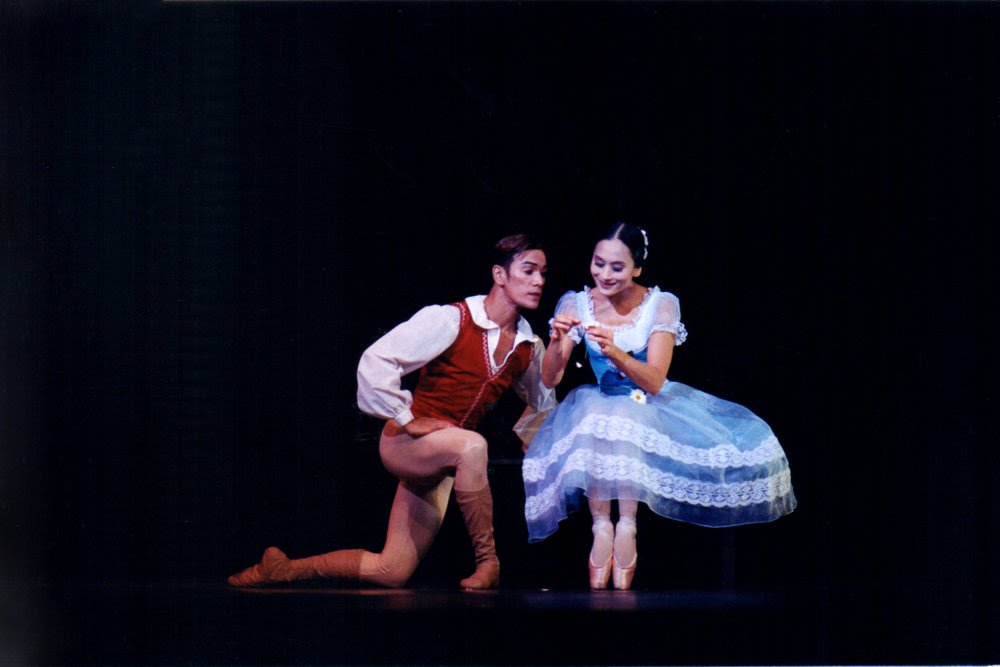
https://balletmanilaarchives.com/home/2019/10/10/giselle-through-the-years%3Fformat%3Damp
Between lovers, the stalker revealed that the newcomer wasn’t a peasant, rather it acts as one, showing the sword from the newcomer this could be used as a sign of betrayal. Beforehand, the stalker tried to get Giselle’s love but failed causing a revelation between two lovers. This leads Giselle to have a heart attack from confusion and heavy drama of the tangled event. Following to the second act, which shows the death, rather the after death of Giselle. The after death of Giselle, features all women presentation as a ghost also the two lovers were present in some scenes but focuses on the grave of Giselle. The act could be considered as bias, the scene only plays women as the ghost and no men were present as a ghost. This only implies that women are weak and overly emotional compared to men which are not presented as ghosts rather an actual living person. The women are repeatedly dancing through the music which could represent that women are limited to certain things, routines that shows softness and demure of women. Another scene done in the ballet wherein the lead ghost attempt to turnover the holiness of Giselle because of the lovers of Giselle that remains unforgiven. Before the scene, the ghosts haunted the place, scaring the two lovers individually – this could mean the ability of women to be dominant or at least show women power. Going back to the act wherein the ghost lead rejects Giselle, Giselle then breaks through and showed love to her lover, specifically the newcomer. The action Giselle took represents the breaking through gender stereotypes, leaving demure ghosts and having affection to her lover that her mother opposes to. The two acts generally shows the patriarchal of traditional practices being Giselle as the anti-patriarchal representation.
 ThIs iS a BlOg